

Correct tooth brushing is brushing that keeps the oral cavity (teeth, gums, tongue, cheeks) clean without wearing it down. Proper tooth brushing should not be confused with tooth brushing techniques.
Many times, my patients with particularly clean mouths ask me what the correct brushing is and I tell them that the correct brushing is what they already do. That is, the correct brushing should be judged by the result and the brushing technique should be adapted according to the structure, morphology of the mouth and teeth as well as lifestyle, habits and how well the patient can manage using the toothbrush.
Proper brushing should clean the teeth of food debris and remove dental plaque. That is why we should remember that teeth have 3 sides that can be cleaned with a toothbrush.
What NOT to do
- Do not wet the toothbrush or toothpaste. It’s wrong. The goal is not to put laundry in the mouth making a thick soapy lather, but to stick the toothpaste on the teeth directly, which in turn will absorb ingredients from it. At the same time, the toothpaste will help, as a kind of lubricant, so that the bristles of the toothbrush are not able to scratch the teeth.
- You should not brush the outer and inner surfaces of the teeth perpendicular to them! It’s wrong. Just as when you want to sand a piece of wood, without damaging it, you should go with its “waters” and not perpendicular to them, so the teeth have a brushing direction and this is from the gums to the teeth and not vertically. The occlusal areas of the teeth (the areas we chew) are the only ones that can clean with a vertical movement. Vibrations perpendicular to the teeth are used in the bass technique.
- Do not press the toothbrush too hard on the teeth and gums. Also do not stroke the gums and teeth with the toothbrush without any pressure. In the first case you will be able to clean your mouth, but at the same time there is a serious risk of wearing down your teeth. In the second case, you are simply wasting your time, as you are not cleaning your teeth and gums. The toothbrush should work on the teeth and gums with light pressure.
- Do not rinse your mouth vigorously.Brush more of what bleeds. Bleeding gums during brushing indicate possible gingivitis. Visit your dentist so he can combat the cause of gingivitis. Healthy gums do not bleed during brushing.
- Do not stop brushing if any part of the gum bleeds. Toothpaste washes off very easily so your teeth don’t have time to absorb the fluoride, especially if you’re used to brushing your teeth for less than 2 minutes.
What should you do?
- Make brushing your teeth a part of your daily routine. Dental health is simply a habit. Get it and you will save a lot of dental treatment costs.
- Brush at least twice a day for at least 2 to 3 minutes. This is approximately the time required for your teeth to absorb the necessary substances from the toothpaste. Time yourself.
- Always brush your teeth before going to bed At night, the productivity of saliva (which acts as a natural mouth cleaner) drops, resulting in the acceleration of tooth decay.
- Change your toothbrush often. If you see the bristles of the toothbrush diverging from the head, throw it away and buy a new one, as these bristles can injure your gums. Change your toothbrush every 3 to 4 months.
- Use dental floss, as there is no other way to clean the areas between the teeth.
- Use mouthwashes, as they help the hygiene of your gums quite a bit.
- Use dental floss, as there is no other way to clean the areas between the teeth.
- Visit your dentist regularly even if you are not in pain. Prevention will save you from painful experiences as your dentist can solve minor problems easily, quickly and painlessly before they develop into painful problems.
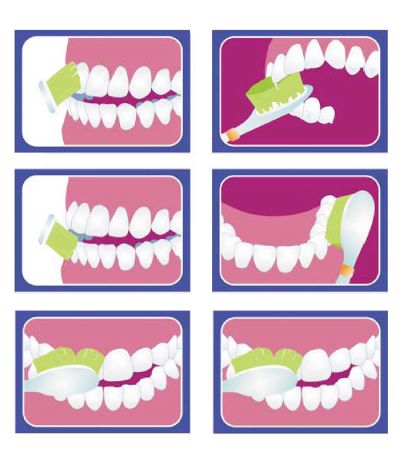 To my patients who have not settled on an effective proper brushing technique, we suggest they try a variation of the American technique.
For the more advanced, we recommend the Bass Technique as a complementary plaque removal technique under the gums.
In some patients we recommend the use of an electric toothbrush.
